

How To Choose The Right Garage Pressure Washer Attachments 2026
Most garage owners buy a pressure washer and stop there. That is a mistake. The machine is just the engine; the attachments are the hands. If you are trying to strip paint off a workbench, clean oil stains out of concrete, or wash a car without scratching the clear coat, your nozzle choice dictates whether you succeed or ruin the surface. I have stripped enough old toolboxes and washed enough shop floors to know that buying the wrong wand or tip is cheaper than it looks in terms of wasted time and damaged equipment.
Quick Answer
To choose the right garage pressure washer attachments, match the nozzle color code to your task: use a red (0-degree) tip only for tough grease on concrete, yellow (15-degree) for general floor cleaning, and white (40-degree) for cars or delicate surfaces. Always pair these nozzles with a surface cleaner attachment for flat floors to prevent streaking, and never skip the soap injector if you are dealing with automotive fluids.
Table of Contents
Our Top Picks
Affiliate disclosure: if you buy through these links, we may earn a commission at no extra cost to you.


Understanding Nozzle Color Codes
Pressure washer nozzles are color-coded by the degree of spray angle. This is not marketing fluff; it is physics. The smaller the angle, the higher the pressure concentration and the greater the risk of damage. In a garage environment, you are dealing with mixed materials: concrete floors, metal tool cabinets, painted walls, and your own vehicle.
The red tip (0-degree) creates a laser-like stream. It is powerful enough to strip paint or remove deep-set tire marks from concrete, but it will gouge wood, chip masonry, and shred car paint in seconds. Use this sparingly. The yellow tip (15-degree) is your workhorse. It offers a balance of cleaning power and safety for most garage tasks, including washing down the shop floor or cleaning out engine bays.
The white tip (40-degree) provides a wide fan. This is safe for cars, bikes, and delicate aluminum parts. If you need to rinse soap off a truck bed or clean a dusty workbench without damaging the finish, this is your go-to. Avoid the green (25-degree) tip in the garage; it sits in a dangerous middle ground where it might be too aggressive for paint but not quite effective on concrete.
The Surface Cleaner Advantage
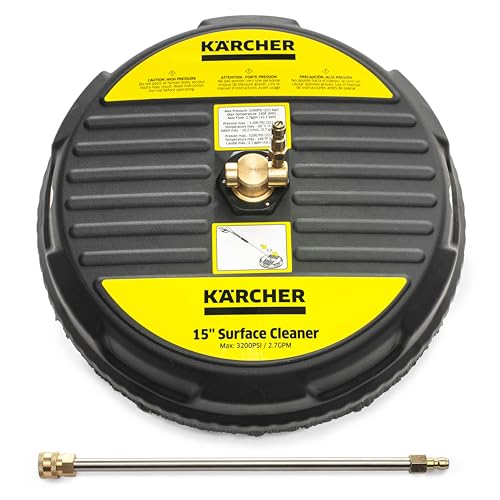
If you only buy one attachment, make it a surface cleaner. This is a circular head that sits flat on the ground and houses multiple nozzles underneath. It uses the pressure to create a vacuum effect that lifts dirt rather than just pushing it around. Without a surface cleaner, you will get the classic "zebra stripe" pattern on your garage floor—clean lines where you passed and dirty streaks where you didn't.
A good surface cleaner also protects your feet and knees. You are not wrestling a high-pressure wand against the ground. You simply push it forward. For a standard two-car garage, look for a unit with a 17-inch to 20-inch cleaning path. This width covers enough ground to make the job feel fast without being unwieldy.
Ensure the surface cleaner has swivel jets and a durable housing. Cheap plastic housings crack under the torque of the internal jets. Metal or high-impact polymer bodies last longer in a shop environment where they might get kicked around or dropped from a truck bed.
Soap Injectors and Chemical Management
Pressure alone does not clean oil stains; chemistry does. A soap injector (or downstream injector) allows you to draw detergent from a bottle and mix it into the water stream. For automotive tools, workbenches, and garage floors, this is non-negotiable. Oil and grease are hydrophobic; water slides right over them. You need a degreaser to break the bond.
Look for an injector that allows you to adjust the flow rate. Some jobs need heavy foam (like washing a car), while others need a light mist (like rinsing a workbench). A fixed-flow injector limits your control. Also, check the material of the intake tube. Rubber or reinforced nylon resists kinking and chemical degradation better than thin plastic.
Never use standard household dish soap in a pressure washer unless it is specifically formulated for that purpose. The suds can damage the pump seals. Stick to pressure-wash-safe degreasers for concrete and automotive-specific cleaners for your tools and vehicles.
Extension Wands and Reach
Your garage is a three-dimensional space. You need to reach high shelves, the underside of your truck bed, and the corners of the ceiling where cobwebs gather. A standard wand is often too short for these tasks. An extension wand adds 18 to 36 inches of reach, allowing you to clean vertically without climbing a ladder constantly.
Choose a wand with a metal shaft if possible. Plastic wands can flex under high pressure, reducing cleaning efficiency and causing fatigue in your arms. A rigid wand transfers all the power directly to the nozzle. Also, look for a swivel connector at the base of the wand. This prevents the hose from twisting as you move the wand around, which extends the life of your hose fittings.
If you have high ceilings or tall storage racks, consider a rotating wand attachment. These wands spin the nozzle automatically, providing even coverage on vertical surfaces like garage doors or tall cabinet sides without you having to sweep back and forth manually.
Quick Connects and Durability
The connection point between your hose, wand, and nozzles is the weakest link in most setups. Cheap quick-connect fittings fail under pressure, leading to leaks and lost time. Look for brass or hardened steel fittings with a robust locking mechanism. The "click" should be firm and audible. If it feels loose, it will pop off when you pull the trigger.
Ensure your attachments are compatible with your specific pressure washer model. Most use standard GCV (General Consumer Valve) connectors, but some brands have proprietary systems. Check your manual before buying third-party attachments. Universal kits are available and often provide better build quality than the OEM parts that come in the box.
Inspect the O-rings inside the fittings regularly. A single cracked O-ring can drop your pressure by 20% or more, making every attachment less effective. Keep a spare set of O-rings in your toolbox. It is a small investment that prevents major headaches.
Frequently Asked Questions
Can I use a 0-degree nozzle on my car?
No. A 0-degree nozzle is too concentrated and will strip paint, damage seals, and crack trim in seconds. Use a 40-degree white tip for vehicles.
Do I need a surface cleaner for a small garage?
Yes. Even in a small space, a surface cleaner prevents streaking and saves time. It also protects your back by allowing you to stand upright while cleaning.
How do I clean oil stains on my concrete floor?
Use a dedicated concrete degreaser with a soap injector. Let it dwell for 10 minutes, then use a yellow (15-degree) nozzle or a surface cleaner to rinse it off.
Are brass quick-connects better than plastic?
Yes. Brass fittings are more durable, resist corrosion, and maintain a tighter seal under high pressure than plastic ones.
Can I use hot water attachments in my garage washer?
Only if your pressure washer is rated for hot water. Using hot water attachments on a cold-water-only machine can damage the pump seals and void your warranty.
Choosing the right attachments transforms your pressure washer from a simple hose into a versatile shop tool. By understanding nozzle angles, investing in a surface cleaner, and using proper chemicals, you can tackle any garage cleaning task safely and efficiently. Start with the yellow nozzle and a surface cleaner for your next project, and keep the red tip reserved for the toughest jobs.


