

How To Choose The Right Garage Air Compressor Hoses 2026
Most guys buy their compressor before they think about the hose. That is a mistake. Your air line is the bottleneck of your entire shop. If the hose restricts flow, your impact wrench chokes out on lug nuts and your spray gun sputters on the final coat. A bad hose adds unnecessary weight, creates tripping hazards, and drains power from your compressor’s motor. Stop treating it like an afterthought.
Quick Answer
For general garage work, choose a 3/8-inch inner diameter (ID) polyurethane hose with a minimum 150 PSI rating. For high-demand tools like sanders or heavy impact wrenches, step up to a 1/2-inch ID. Always prioritize the coupling quality over the hose length; a long hose with cheap fittings will fail faster than a short hose with industrial-grade brass.
Table of Contents
Our Top Picks
Affiliate disclosure: if you buy through these links, we may earn a commission at no extra cost to you.
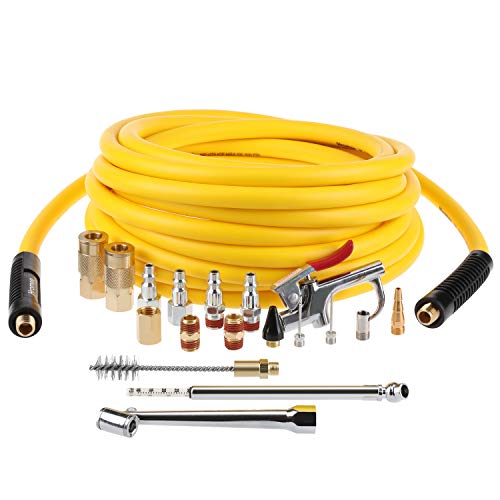


Inner Diameter Matters More Than Length
The biggest mistake I see in home garages is buying a 50-foot hose with a 1/4-inch inner diameter (ID). That setup works for inflating tires or running a brad nailer. It fails completely when you try to run a die grinder or a paint gun. Air volume (CFM) drops exponentially as the path gets narrower and longer.
Think of the hose like a water pipe. If you put a garden hose nozzle on a fire hydrant, you get a weak stream. Same physics apply here. You need enough cross-sectional area to move the air your tools demand without pressure drop. A 3/8-inch ID is the sweet spot for 90% of automotive and woodworking tasks.
Material Breakdown: Poly vs. Rubber vs. Nylon
You have three main choices for hose construction. Each has a specific place in the shop.
- Polyurethane (The Standard): This is what you see on most new compressors. It is lightweight, kink-resistant, and cheap. The clear or colored plastic lets you see moisture buildup inside. However, it can become brittle in freezing temperatures and may degrade if exposed to oil-based paints.
- Rubber (The Workhorse): Heavy, stiff, and durable. Rubber hoses handle heat better and resist abrasion from rough concrete floors. They last longer under heavy industrial use but will tire your arm out after a day of overhead work.
- Nylon (The Performance Choice): Often used in high-end pneumatic systems. It has a smoother inner wall for less friction and higher flow rates than polyurethane. It is more expensive but offers the best balance of durability and airflow.
Avoid cheap, coiled "telephone-style" hoses for anything other than quick tire inflation. The internal ridges create massive turbulence, restricting airflow significantly. They also tend to snap at the connection points after a few months of tension.
Fittings and Couplers: The Weak Link
The hose is only as good as its weakest fitting. I have seen guys buy $40 hoses with plastic couplers that strip the threads or leak air within a week. Air leaks are money leaks. A single 1/8-inch pinhole leak can cost you hundreds of dollars in electricity annually because your compressor cycles on and off constantly.
Look for brass or zinc-plated steel fittings. Brass is preferred because it does not spark, which is critical if you are working near flammable vapors in a garage. Ensure the coupler has a shut-off valve (the "quarter-turn" feature). This allows you to disconnect your tool without losing all the air pressure in the line.
Sizing for Your Specific Tool Kit
Match the hose to the tool that demands the most air. If you only run a ratchet and an inflator, a 1/4-inch ID is fine. But if you own a paint gun, a sandblaster, or a heavy-duty impact wrench, you need more volume.
- 1/4-inch ID: Good for nailers, staplers, and tire inflators. Avoid for spray guns.
- 3/8-inch ID: The universal standard. Handles impact wrenches, ratchets, and most spray guns effectively.
- 1/2-inch ID: Required for sanders, grinders, and high-CFM air hammers. Essential if your compressor is under 60 gallons.
If you are unsure of your tool's CFM requirement at 90 PSI, check the manual. Add a 20% buffer to that number. If the hose cannot deliver that volume, your tools will not perform at their rated power.
Safety and Longevity in the Shop
Air hoses are under high pressure. When a cheap hose bursts or a fitting blows off, it becomes a dangerous whip. Always inspect your hoses before use. Look for cracks, especially near the fittings where flexing happens most.
Use hose reels or overhead retractors. Dragging a hose across a concrete floor abrades the outer layer and exposes the inner liner to cuts. A reel keeps the line off the ground, protects it from vehicle traffic, and makes setup time zero. It also prevents the "hose snake" effect where the line coils around your legs while you work.
Frequently Asked Questions
Can I use a garden hose for air?
No. Garden hoses are not rated for compressed air pressure and can explode violently. They also contain materials that can contaminate your pneumatic tools with bacteria or debris.
Does hose length reduce air pressure?
Yes. Every foot of hose adds friction, which reduces volume (CFM). A 100-foot hose will deliver significantly less power to your tool than a 25-foot hose, even if the compressor output is the same.
Should I use Teflon tape on air fittings?
Only on threaded connections that seal with threads (like the inlet to the tank). Never use it on quick-connect couplers or O-ring face seals, as the tape can flake off and clog your tool valves.
What is the standard size for garage air hoses?
The industry standard for automotive and woodworking shops is a 3/8-inch inner diameter hose with 1/4-inch NPT (National Pipe Taper) fittings.
How do I stop moisture from getting into my tools?
Install an in-line water trap or filter at the end of your hose, near your workbench. Drain your compressor tank daily to prevent moisture buildup at the source.
Is a coiled hose better than a straight hose?
Coiled hoses are convenient for storage but restrict airflow due to their internal ridges. Use them only for low-demand tasks like tire inflation. For any tool requiring sustained air, use a straight hose.
Your air compressor is the heart of your shop, but the hose is the vein that delivers the lifeblood. Invest in a high-flow, durable hose with quality brass fittings. It will save you time, money on electricity, and frustration at the bench. Upgrade your line today, and watch your tools perform like new.


